
Podcasts & audio stories from the Musée GRATALOUP
The voice of the Musée GRATALOUP is distinctive. It accompanies the artworks by giving words to those fleeting moments when a space opens and a new understanding emerges. Shaped by a particular moment, a specific environment, and the author's personal history, it does not claim to be universal. It remains an act of transmission, offering a message that may be received, transformed, or simply forgotten.
This page does not bring together every podcast produced by the museum. Instead, it presents a selection of audio stories chosen for their evocative power and their connection to the museum's virtual exhibitions. Each listening experience offers a way into an artwork and an invitation to continue the journey through the exhibition.
Seeing differently: the visible, the invisible, and emergence
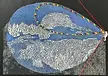
The meaning of an artwork emerges through the encounter. Its color depends on the light and the viewer
The painter's eye I
I dreamed the Mountain — GRATALOUP
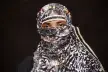
What the world does to women when it can only function by making them invisible
Rabeya
Woman — Yann ARTHUS-BERTRAND

C’est une toile ancienne des années 70. Je l’ai appelée l’œil du peintre. On y voit les montagnes en arrière-fond. Leur paysage est monochrome. La petite silhouette du peintre est sur le bord du tableau, presque hors du paysage. Il est dans le noir c’est-à-dire le mystère, là où toutes les couleurs se forment. Et il est aussi hors de son œil. Son œil regarde les montagnes et des rayons rouges éclairent les ténèbres. Son œil est semblable à une bulle polychromatique qui donne des couleurs à la vie. Car en réalité tout est gris. Seule la lumière et celui qui la regarde sait de quoi sont faites les montagnes et les expériences de la vie.

Just a glance from a face hidden behind a leopard-print veil.
The woman exists, but without a face. In the public sphere, Rabeya is not a subject. No one recognizes her.
Yet Rabeya is not absent. The world does not erase her completely. It keeps her at a threshold where she is present, but not representable. She remains visible and can look back, yet her voice is constrained. She takes no part in the decisions that shape society.
This is the portrait of a woman in an ordinary world where violence is not spectacular. It is the portrait of a silent condition in which women are not decision-makers. It reveals what a society must remove in order to keep functioning as it does.
Light, matter, transformation

The light of lightning when it reveals an inner realm
Landscape to the ideal city
I dreamed the Mountain — GRATALOUP

When crumpled paper transforms drawing into living matter
Buddha discovers the stars – Crumpling
The Warrior Painter — KIJNO

This canvas symbolizes personal transformation. The mountain shifts from the black of the hidden and the unfathomable to the bright white of knowledge. From this contrast between two opposing forces arises the lightning that reveals shapes and colors.
The small silver figure of the man is an intermediate shade between black and white, neither warm nor cold, a vessel for all the colors life has to offer. He travels up the mountain, and the golden panorama that opens up in the light of the lightning reveals lines and angles, the sketch of an ideal city, a mirror of his deepest aspirations.
It lasted only for a moment, but the man who stands now is profoundly different.

One day, Kijno drew a horse. Dissatisfied with the result, he crumpled the sheet of paper and slipped it into his pocket.
Later, he came across the crumpled ball of paper again. He unfolded it, and suddenly a horse appeared, cave-like, reminiscent of the paintings at Lascaux, with relief, movement, and life. It was a major discovery. From 1946 onward, Kijno would crumple his works.
Crumpling is an act of violence against the drawing. It transforms it, just as life transforms us. It speaks of the violence of passing time. “A child is born crumpled, the adult becomes smooth, the old person dies wrinkled,” Kijno liked to say. “That is how the world is made. It crumples and uncrumples. We are constantly in motion.”
Throughout his work, Kijno created a ritual between the smooth and the crumpled, a way of generating the disturbance of becoming.
Kijno was not the first artist to use this technique. Paul Klee and Salvador Dalí had done so before him.
But he was the first to use crumpling in this singular way, and to make it a defining element of his entire body of work.
The living world without us

A secret language older and stranger than we can imagine
We speak to one another
The Trees Told Me — GRATALOUP

The tale of the last lake
The last lake
The Colors of Water— GRATALOUP

You think I am insensitive because I have no mouth, no eyes, and no ears. Yet I have a language, one that your scientists are only just beginning to decipher in their laboratories.
It is made of scents carried by the wind, warning of danger, and of electrical signals that travel through my body, from leaves to roots and into the vast network of fungi beneath the soil. Made of filaments so fine that a single fungus can spread across an entire forest, this network is by far my most effective and most secret messenger.
Through it, we are all connected, exchanging the information essential to our survival.
So yes, I am a living, sensitive being.
And if you wish to be convinced, come and walk through the forest. Walk without purpose, simply allowing your body to guide you. The whisper of the forest will enter you, and you may be surprised by the serenity you find there.

It was the last lake. Strange to think that once, water had flowed freely across the Earth, unnoticed by most. Yet he had always known he was special, with his deep, magnetic hues. Summers were his favorite, filled with the laughter of children playing along his shores.
But everything changed. The heat came like a hammer, turning his banks to dust. The children were long gone, yet he endured. Deep within his core, a small pocket of water persisted. Sometimes, he wondered: who was he holding on for? And so, time passed… endlessly.
One day, he felt a stirring deep in the ground. Light pierced the surface. Machines descended, the remnants of a desperate humanity clawing for survival. They had found him, and his depths began to collapse. He realized, in that moment, that he wasn’t a survivor. He was a resource.
In one final act of defiance, he released the pressure that had built within his depths. The explosion sent torrents of water surging through the human tunnels. In that furious flood, the last lake gave everything it had.
When silence returned, the lake was gone, leaving behind only a thin crust of salt on the stones, and a truth etched in the stillness: it wasn’t the lake that had failed to survive. It was humanity that had failed to protect it.
Trial, war, resistance
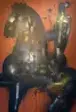
Painting against all wars
Xian Horseman in Majesty – The Struggle
The Warrior Painter— KIJNO

What the world does to women when freedom must change nothing
Ryu Hwa
Woman — Yann ARTHUS-BERTRAND

“Painting is a profession that kills,” Kijno said. “One way or another, you have to leave your skin behind.”
Kijno was angry. Kijno was at war. At war against all wars, which he denounced in his series The Horrible Coats of Arms of War. His paintings cried NO to the Algerian War, such as OAS Assassin. His works wept NO to Vietnam, as in The Burned Child. He campaigned alongside Angela Davis in support of Black civil rights. He was always there, raising his voice against injustice and every form of oppression.
Kijno entered the struggle with the only weapon he knew: what he called “the slowed language of brushes,” a language that creates distance and reveals reality as it is. Across his canvases, horsemen gallop toward love and peace. And to give humanity a chance of survival, he painted great icons, guardians against catastrophe.

Ryu Hwa exposes her body. Her markings and tattoos speak in her place.
She hides nothing. Yet she controls everything, down to the precise red swirl drawn high on her cheek.
In the street, she does not go unnoticed. People see that she is expressing herself. They glance, perhaps turn their heads, and then move on. The order of the world remains undisturbed. Ryu Hwa has indeed transgressed. She is highly visible, yet she remains alone. It is her business, her personal story. And so the world tolerates her, because she does not overflow its boundaries.
As long as it does not become a collective gesture, as long as it does not become a force for change, freedom is allowed to exist.
Provided that it changes nothing.
Body, birth, passage

Born from water, in the shadow of hardship
Mother's edge
Living Body — GRATALOUP

Passage
Bather at the white wave
Living body — GRATALOUP

What better way to represent motherhood than through water, the sea from which all life on earth originates?
The woman on the beach is crouched in the shadow to give life. The black that surrounds her represents the color of trial, the risk of death, and being set apart from the world. Even though two were involved in the conception, the woman is alone in giving birth.
Alone? Is that really certain? In many cultures, the right triangle symbolizes the masculine principle. In this painting about motherhood, the shadowy right triangle of the man provides a protective refuge for the woman, and the large golden brass triangle proclaims to the world the birth of a little one.

This canvas is arguably the most symbolic in the entire exhibition. A body, severed in two, rises within a silver tunnel amidst a white monochrome. White is associated with purity and transcendence, but also with the pallor of the dead and mourning. Therefore, it represents the death of the body, tired, damaged, split in two by the trials of life. The white wave of death opens a tunnel, with the silver color suggesting purity and purification.
The body ascends in this passage, a transition to elsewhere.